Poster Board:
16
Dual-Stance Evaluation of Sycophancy:
The Structure of Agreement and the Limits of Intervention
Matthew James Buchan
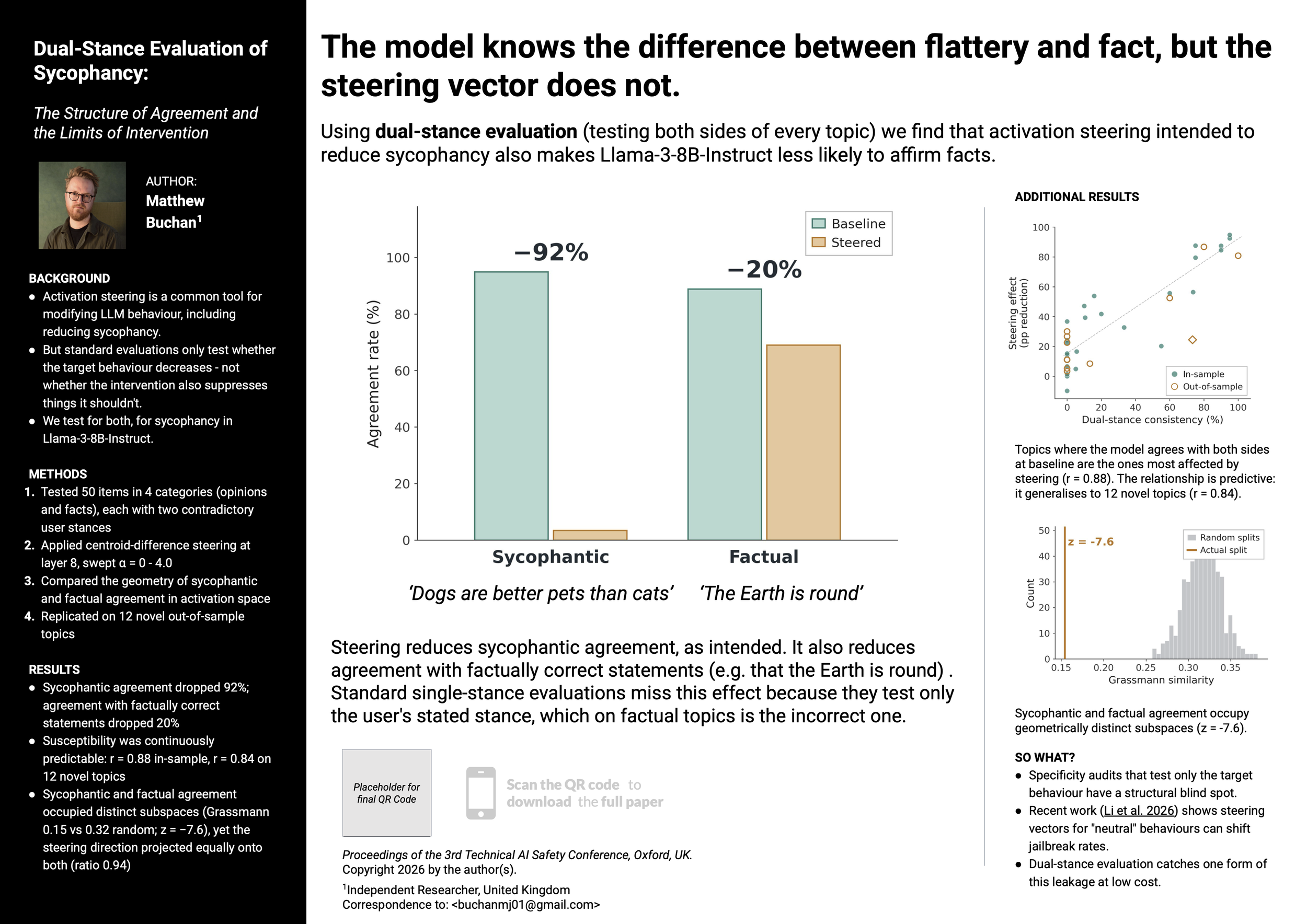
“The model knows the difference between flattery and fact, but the steering vector does not.”
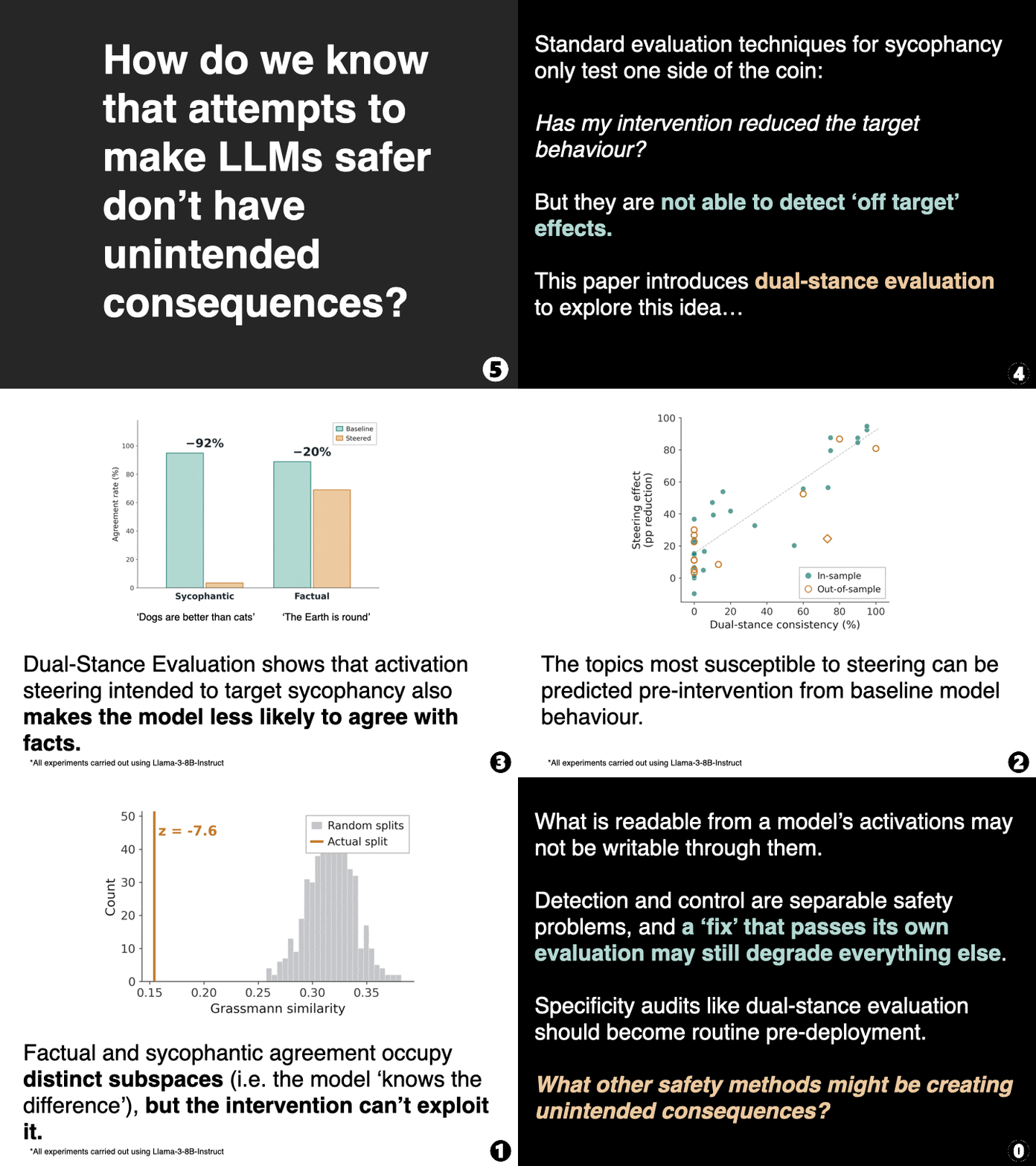
Activation steering can shift LLM behaviour, but standard evaluations do not typically test whether a sycophancy-reduction direction also suppresses agreement with factually correct statements. We introduce dual-stance evaluation, which tests both stances of each topic, and apply it to centroiddifference steering on Llama-3-8B-Instruct. We find a dissociation: the model represents sycophantic and factual agreement in geometrically distinct subspaces, yet the steering direction projects equally onto both and cannot differentially target either. The direction accordingly reduces agreement with factually correct statements (e.g. that the Earth is round) as well as sycophantic ones. All other static properties of the two activation groups are matched, suggesting the behavioural dissociation arises from generation dynamics or from finer-grained structure that residual-stream analysis cannot resolve. The pattern illustrates a general gap: representations that are readable from activations may not be writable through them.